The Best Fundraising Strategy for Small Nonprofits With Stalled Revenue
If your nonprofit's fundraising has flatlined, no matter how hard you're working, the problem probably isn't effort. It's capacity. Here's why fractional fundraising is the strategy that actually moves the needle.
You've done everything "right."
You've hosted the gala. You've sent the year-end appeal. You've applied for grants, thanked your donors (mostly), and sat through more board meetings than you care to count talking about diversifying revenue streams.
And yet, the numbers aren't moving.
Your fundraising has stalled. Not because you don't care. Not because your mission isn't compelling. But because somewhere between the strategic plan and the actual doing of the work, something keeps falling through the cracks.
Sound familiar?
If you're an Executive Director wearing every hat in the building, this is one of the most frustrating places to be. You know what needs to happen. You just don't have the bandwidth to make it happen consistently.
So what's the best fundraising strategy for a small nonprofit stuck in this exact spot?
Let's talk about it...
Why "Just Do More Fundraising" Isn't the Answer
When revenue stalls, the instinct is to do more - more events, more asks, more campaigns. But if your fundraising is already stretched thin, adding more to the pile doesn't fix the problem. It just accelerates burnout.

This is what happens when small nonprofit fundraising stalls:
No consistent donor stewardship. Thank-you notes pile up. Follow-up calls don't happen. Donors feel forgotten and eventually stop giving.
Reactive fundraising. Campaigns happen when there's a crisis, not as part of a steady rhythm. Donors can sense the desperation.
No system behind the strategy. You might have a plan, maybe even a beautiful one from a consultant, but plans don't raise money. Implementation does.
The ED is the fundraising department. When the person responsible for fundraising is also running operations, HR, programs, and board relations, fundraising gets deprioritized. Every. Single. Time.
This is 100% a structural problem, and it needs a structural solution.
The Three Options Most Small Nonprofits Consider (And the Real Trade-Offs)
When fundraising stalls, most Executive Directors start weighing their options. Here's what that usually looks like in practice:

Option 1: DIY - Keep Doing It Yourself
The appeal: No new cost. No onboarding. You already know the donors.
The reality: You're already doing this, and it's not working. The reason fundraising has stalled is because it keeps getting bumped by everything else on your plate. DIY fundraising works when you have dedicated time for it. Most EDs don't.
The hidden cost of DIY isn't in your budget line, it's in the relationships you're not building, the donors you're not retaining, and the revenue you're leaving on the table while you handle the next operational fire.

Option 2: Hire a Junior Fundraiser
The appeal: Dedicated capacity. Someone in-house. A body in the seat.
The reality: Junior fundraisers typically need significant supervision, coaching, and mentorship to be effective, which falls back on you. The average nonprofit development staff member leaves within 18 months, according to research from the Association of Fundraising Professionals. That means you're back to square one, plus the time and cost of rehiring.

Option 3: Hire a Fundraising Consultant
The appeal: Senior expertise. Strategic direction. A real plan.
The reality: Most consultants deliver the plan and walk away. You're left with a beautiful 40-page document and no one to execute it. This is what's sometimes called the implementation gap, and it's one of the most common (and expensive) frustrations in the nonprofit sector.
We heard this firsthand from an Executive Director we spoke with recently. She’d hired a consultant, received a detailed fundraising plan, and then hit a wall. As she put it:
“Yes, it was a good plan, it was well-rounded, but was it really right-sized for our capacity?”
That’s the issue right there. Because that’s exactly it. A plan built without the person who has to implement it in mind isn’t really a plan. It’s a wish list.
Great advice you can't implement isn't great advice. It's just an expensive shelf decoration.
What Makes Fractional Fundraising Different
Here's where fractional fundraising changes the equation, and why it's become one of the most effective strategies for small nonprofits with stalled revenue.
Fractional fundraising gives you senior-level expertise and hands-on implementation, at a fraction of the cost of a full-time experienced hire.
Instead of choosing between a plan you can't execute or a junior hire you have to supervise, fractional fundraising combines all three things stalled nonprofits actually need:
→ Strategic direction — a tailored fundraising plan built around your mission, your donors, and your stage of growth.
→Clear, consistent planning — campaigns, stewardship, appeals, and donor touchpoints mapped out and scheduled so nothing falls through the cracks.
→ Hands-on implementation — the actual doing. The emails. The reports. The acknowledgements. The systems. Executed reliably, every month.
It's not consulting. It's not a part-time employee. It's a senior fundraising partner who takes ownership of your fundraising programand runs it, so you don't have to.
The Flywheel Effect: From Stalled to Sustainable
One of the biggest misconceptions about stalled fundraising is that it needs a dramatic turnaround - a blockbuster campaign, a major donor gift, a viral moment.
Most of the time, it doesn't.
What stalled fundraising actually needs is consistency. When donors are thanked promptly, when they hear from you between asks, when your communication is regular and meaningful, something remarkable starts to happen. Donors give again. They give more. They refer friends.
This is what we call the fundraising flywheel: a system that, once built and consistently maintained, creates compounding momentum over time.
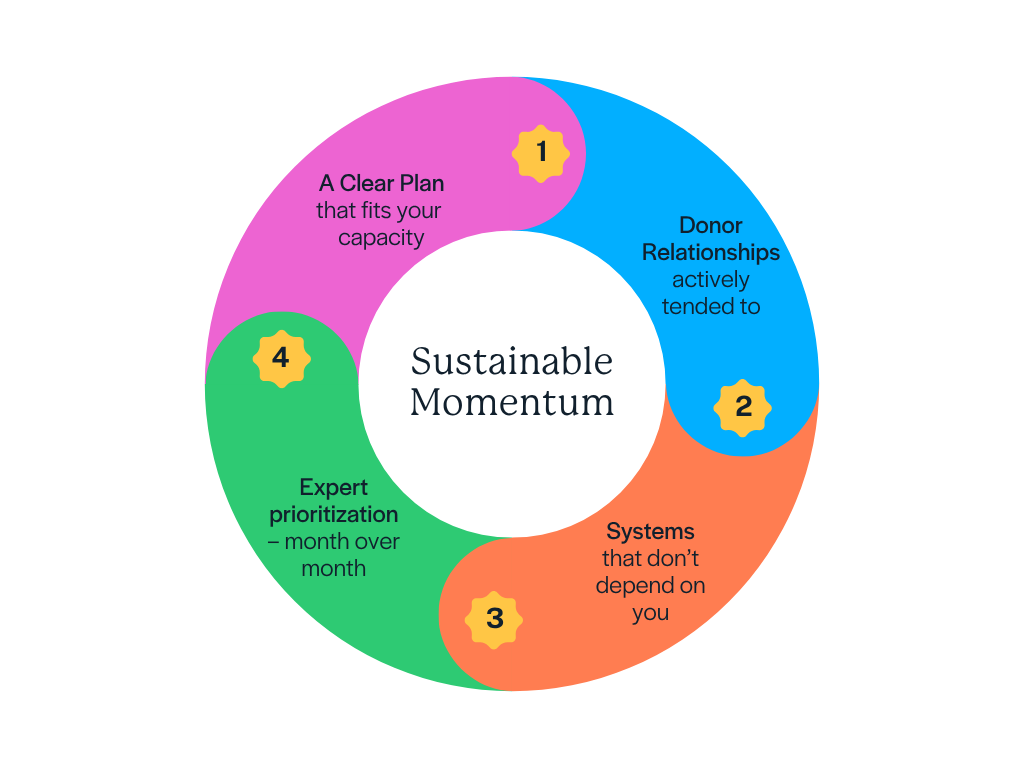
It doesn’t happen overnight. But it also doesn’t require a miracle. It requires:
A clear plan that reflects your organization's unique situation
Donor relationships that are actively tended to
Systems that don't depend entirely on you to function
Someone with the experience to know what to prioritize and when
Fractional fundraising builds that flywheel. Consistently. Month over month.
"But Will Someone External Really Understand Our Mission?"
This is one of the most common concerns we hear, and it's a fair one.
The short answer: yes, with the right process.
A good fractional fundraiser doesn't parachute in with a generic template. They invest time upfront learning your organization. That means your donors, your history, your culture, your voice. They work alongside your team, not above it or apart from it.
At Sound Fundraising Strategies, our onboarding process is specifically designed to make sure every piece of communication, every campaign, and every donor interaction sounds like you, not like an outside agency.
And because fractional fundraisers work across multiple organizations, they bring something else: perspective. They've seen what works in organizations like yours. They know the pitfalls before you fall into them. That cross-sector experience is genuinely hard to replicate with a single in-house hire.
Is Fractional Fundraising Right for Your Organization?
It might be a strong fit if:
✅ Your ED is currently the primary (or only) person doing fundraising
✅ You have a strong mission but inconsistent fundraising results
✅ You've tried consultants but struggled with implementation
✅ You can't afford - or don't want to manage - a full-time senior fundraiser
✅ Your revenue has plateaued and you're not sure why
✅ You want fundraising to keep moving even when things get busy
It's probably not the right fit if your organization already has a dedicated, experienced fundraising team with consistent systems in place. Fractional fundraising is designed to build that capacity, not supplement something that's already working well.
The Bottom Line
Stalled revenue is rarely about a lack of good intentions. It's almost always about capacity, consistency, and the gap between knowing what to do and actually getting it done.
The best fundraising strategy for a small nonprofit in this position isn't a new tactic or a bigger event. It's closing that gap with expertise that actually shows up and does the work.
That's exactly what fractional fundraising is designed to do.
Curious whether fractional fundraising could be the right move for your organization? I'd love to have a conversation about where you're at and what might actually help. Book a free Discovery Call and let's figure it out together.