Fractional Fundraising: Why Small Nonprofits Are Choosing It Over Full-Time Hires
Updated December 22, 2025
Fractional fundraising is becoming the go-to solution for small nonprofits because it solves three problems that full-time hires and traditional consultants can't: you get senior-level expertise without the $75K+ salary, hands-on implementation without the supervision burden, and the elimination of turnover risk. For small nonprofits, it's the difference between sustainable fundraising growth and another strategic plan collecting dust on a shelf.
Let's be real - you've probably been told you need to "invest in development staff." But what they don't mention is that the average nonprofit fundraiser stays just 16 months, recruitment costs could vary between $15K-$25K, and junior hires need constant supervision you don't have time to provide.
There's a smarter way.
Why the Traditional Hiring Model Is Broken for Small Nonprofits
You’ve probably experienced this cycle:
The Junior Hire Trap:
You finally get budget approval to hire a Development Coordinator
You recruit, interview, onboard (3+ months before they're productive)
You spend 5-10 hours weekly supervising, training, correcting
They're just getting good… and then they leave for a bigger org
You're back to square one, $20K+ poorer, with donor relationships disrupted
The Consultant Disappointment:
You hire a consultant to create a fundraising strategy
They deliver a beautiful 47-page plan (that cost you money)
They leave, assuming you have capacity to implement
The plan sits on your shelf because you're drowning in operational demands
Six months later, nothing has changed except your bank balance
The DIY Burnout:
You write grants at 11 PM after your kids go to bed
You send donor thank-yous in your car between meetings
Fundraising gets deprioritized because operational fires scream louder
Revenue plateaus or declines
You wonder if you're failing your mission
Sound familiar? You're not alone. And it's not your fault - the system is designed for organizations with big budgets, not small nonprofits doing transformative work on limited resources.
What Makes Fractional Fundraising Different (And Smarter)
Fractional fundraising fixes the broken model by combining what works and eliminating what doesn't:
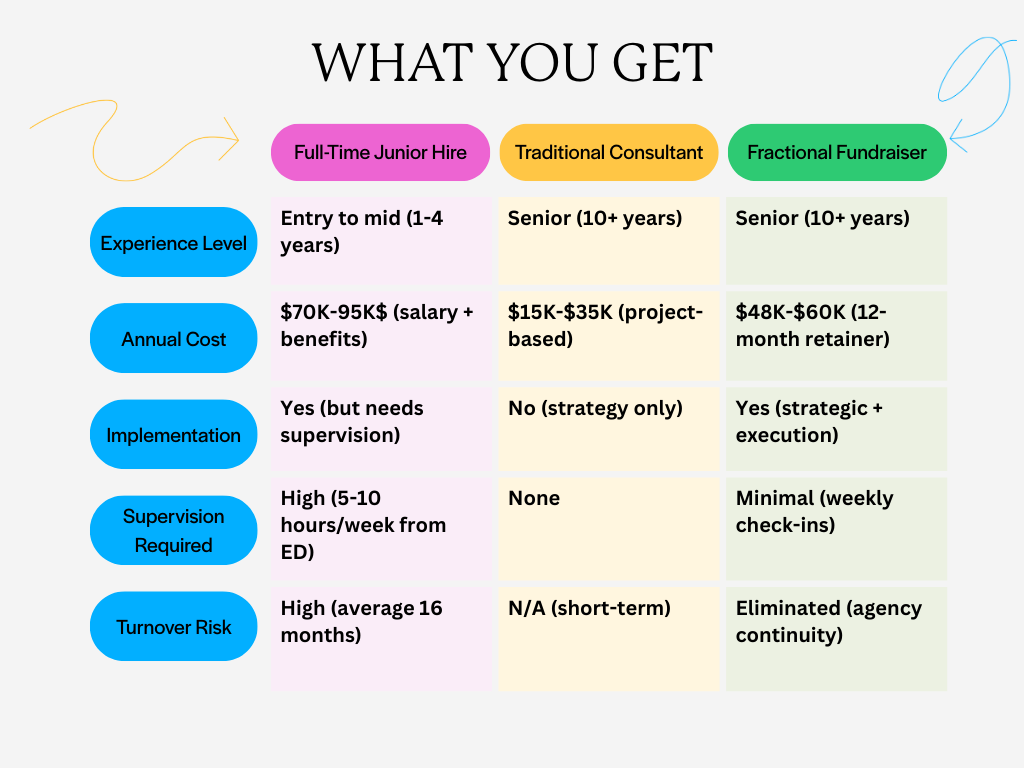
✅ Senior-Level Expertise at Junior-Level Cost
✅ Hands-On Implementation, Not Just Advice
Here's an example of what a fractional fundraiser can achieve with you in a month:
Week 1-2:
15-20 personalized donor thank-you calls/emails sent
Gift processing oversight and data cleanup
Lapsed donor re-engagement campaign deployed
Week 3:
2-3 grant proposals researched, written, submitted
Year-end appeal drafted and designed
Strategy session with ED (not supervision—collaboration)
Week 4:
Donor meeting research and prep
Metrics reporting and strategy adjustment
Next month planning
Real example: In Q4 2025, our fractional fundraiser helped a client (whose mission promotes gender equality) secure $TBD in new grants while raising an additional $TBD through their year-end campaign. The ED said: "I forgot what it felt like to NOT worry about fundraising every weekend."
✅ No Supervision Burden
Unlike junior hires who need:
Training on your donor database
Approval on every email before it goes out
Help crafting their first grant proposals
Weekly 1:1s to keep them on track
Fractional fundraisers:
Hit the ground running (we've done this A LOT)
Bring proven systems and templates
Make decisions independently within agreed strategy
Report TO you, not rely ON you
✅ Agency Continuity = Zero Turnover Risk
The nightmare scenario with staff: They leave right before your biggest campaign.
With the agency model:
You're partnering with Sound Fundraising Strategies (the organization), not just one person
If your primary contact transitions, another team member steps in seamlessly (no burden of onboarding!)
All donor communications, grant deadlines, and strategy are documented in shared systems
Institutional knowledge stays with YOU
The Real Cost Breakdown (No Hidden Fees)
Let's talk actual numbers, because transparency matters.

Full-Time Development Coordinator Estimates:
Salary: $55,000 +
Benefits (25-30%): $16,500
Office space/equipment: $3,000
Recruitment costs: $5,000
Training time (ED's hours): $8,000 (opportunity cost)
TOTAL YEAR 1: $87,500
Risk: They leave in 16 months on average

Traditional Consultant Estimates:
Strategy development: $15K
Implementation: $0 (you're on your own)
TOTAL: $15,000
Gap: Beautiful plan, no execution

Fractional Fundraising :
Monthly retainer: $4,000+ (based on scope)
Annual investment: $48K-$60K
What's included: Strategy + Planning + Implementation + Ongoing optimization
Hidden costs: None. No benefits, no office space, no supervision time, no recruitment.
The Real Cost Comparison (Why Fractional Makes Financial Sense)
Let's cut to the chase with actual numbers:
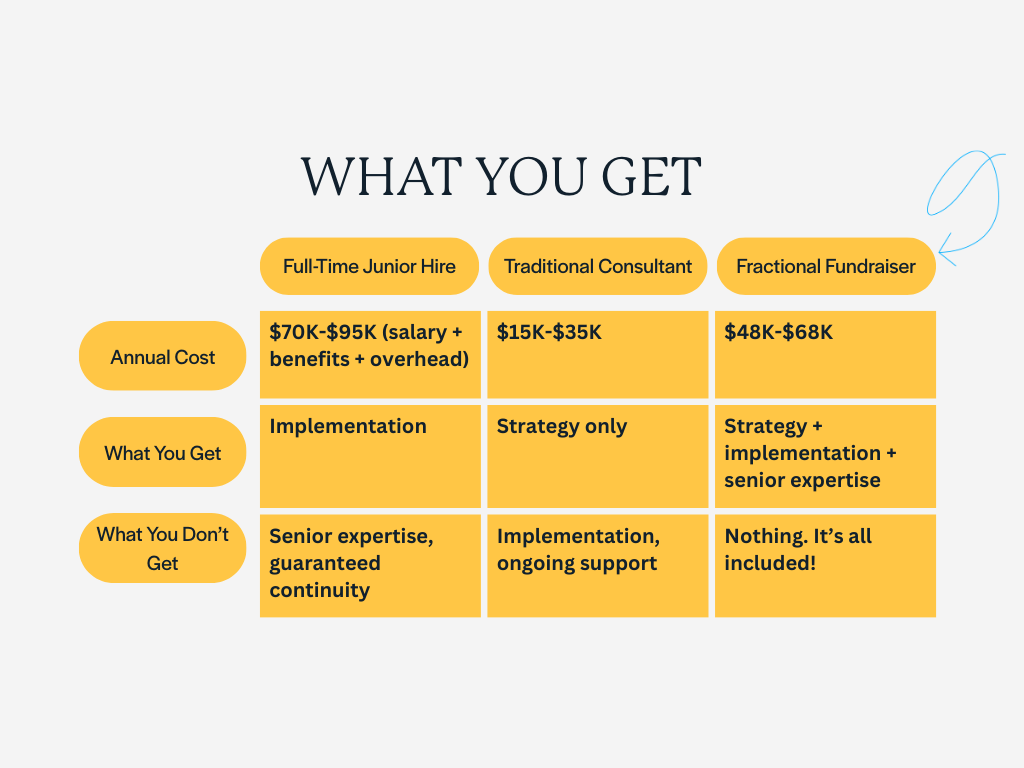
The hidden costs everyone forgets:
Full-time hire: Add $15K-$25K for recruitment, training, supervision time, and turnover risk
Consultant: Add your own time (unpaid nights/weekends) trying to implement their plan
Fractional: No hidden costs. What you see is what you pay.
Bottom line: You get senior-level expertise and hands-on implementation at roughly half the cost of a full-time hire, without the supervision burden or turnover risk.
Why 12-Month Partnerships (Not Lock-In Contracts)
You might be thinking: "Why such a long commitment? What if it doesn't work?"
Here's the truth about fundraising that nobody wants to say out loud:
Fundraising is a flywheel, not a light switch. Here’s an example:
Months 1-3: Foundation building (systems, donor segmentation, messaging, pipeline development)
Months 4-6: Initial momentum (first campaigns, grant submissions, donor moves)
Months 7-9: Growth acceleration (donors respond, grants awarded, strategy adjustment, campaign refinement)
Months 10-12: Sustainable momentum (flywheel spinning, systems humming, retention improves)
If you stop at month 6, you've paid for the setup but won't see the full ROI.
Our 12-month structure protects YOUR investment, without locking you in. We're confident on our ability to deliver results over time based on expertise, not trapping you in a contract.
Payment structure: Monthly retainer, not upfront annual fee. You pay as you go.
Why Small Nonprofits Are Making the Switch
The nonprofit sector is shifting. Smart EDs are realizing:
The old model: Hire cheap, supervise constantly, lose them in 16 months, repeat.
The new model: Partner with fractional experts who implement, deliver results, and stick around.
Ready to Stop Doing Fundraising Alone?
If you're an Executive Director who's tired of writing grants at midnight, wondering why your donor retention keeps dropping, and secretly worrying that you're failing your mission because you can't figure out fundraising—you're not failing. The system is.
Here’s What Happens Next:
Schedule a discovery call to discuss your fundraising challenges and goals
Receive a customized proposal outlining scope, timeline, and investment
We match you with a SFS fundraiser that aligns with your needs and work style
Begin partnership with comprehensive discovery and strategic planning
No pressure. No pitch. Just an honest conversation about whether we can help you build the sustainable fundraising your mission deserves.